Choosing between HeyGen and Colossyan comes down to more than avatar quality or monthly price. I tested both to see how they handle real video workflows, from avatar creation and voice quality to marketing content, training videos, ease of use, translation, and scaling.
The biggest difference is clear: HeyGen offers a broader video-production workflow, while Colossyan focuses more tightly on simple avatar and training content. Your best choice depends on how much flexibility you need and how you plan to use the platform.
HeyGen vs Colossyan — Quick Comparison (TL;DR)
| Feature | HeyGen | Colossyan |
|---|---|---|
Overall Rating | ||
Avatar Realism | Winner — strong realism and lip-sync in hands-on testing | Good with public avatars, but custom avatars were noticeably artificial |
Video Workflow | Winner — avatars plus translation, B-roll, images, podcasts, UGC, highlights, and batch creation | More focused on avatar-led videos and document-to-video |
Ease of Use | Excellent — simple workflow with a broad set of guided tools | Excellent — particularly straightforward for document/script-to-video |
Pricing |
| Starts around $19/month annually; Business is around $70/month |
Best for | Scalable AI video production, marketing, social content, localization, and creator workflows | Training, education, onboarding, and document-to-avatar videos |
Localization |
| Multilingual creation is supported, but the review notes some languages can need additional review |
Content scaling | Winner — Batch Mode can generate multiple versions with different scripts, avatars, voices, or languages | Better suited to repeatable training and structured content workflows |
The hands-on reviews point to a fairly clear difference: HeyGen is the broader video-production platform, while Colossyan is the more focused content-to-avatar tool. Colossyan’s document workflow and simplicity are genuine strengths, but the review found its custom-avatar quality and overall feature depth limiting.
heygen
Create professional AI videos from simple text using realistic avatars, without filming, editing skills, or expensive production setup.
Key Features:
Pros:
Cons:
Colossyan
Turn your documents or scripts into professional avatar videos in minutes—saving time, cutting costs, and removing the need for filming or editing.
Key Features:
Pros:
Cons:
HeyGen vs Colossyan — Feature-by-Feature Comparison
Avatar Realism
I found HeyGen’s avatars more realistic overall, with natural-looking movement, strong lip-sync, and expressions that made the videos feel close to human delivery. In my testing, this gave me a more convincing result for regular content without making the avatar feel obviously artificial, although some expressions still felt slightly off in longer or more complex videos. I would choose HeyGen when avatar realism is a top priority.
I found Colossyan’s public avatars reasonably natural, but its custom avatars were a clear weak point, with stiff head movement, limited body language, and an artificial overall appearance. In my workflow, this made custom-avatar videos harder to trust when I wanted a convincing digital version of a real person. I would choose Colossyan for simple avatar videos, but avoid it if custom-avatar realism matters most.
AI Voice Quality, Lip Sync & Translation
I found HeyGen’s voices natural, while its lip-sync and multilingual output made the finished videos feel convincing for most regular content. In my workflow, I could create and translate videos quickly, although I noticed that deeper emotional delivery can still feel scripted and complex videos may show small sync issues. I would choose HeyGen for creators who need reliable multilingual video production at scale.
I found Colossyan’s voice and translation workflow useful for basic multilingual videos, but tone and expression could feel slightly off in some languages. In my workflow, that meant I needed to review translated videos instead of assuming every version was ready to publish. I would choose Colossyan for straightforward training content, but I would prefer HeyGen when natural multilingual delivery is a major priority.
ease of use
I found HeyGen easy to use, with a simple dashboard, clear navigation, and a quick path from script to finished video. In my workflow, I could choose an avatar, add a script, select a voice, adjust the format, and generate a video without dealing with complex production steps. I would choose HeyGen for beginners and creators who want speed without sacrificing useful creative options.
I found Colossyan simple to use, especially when turning existing documents into avatar videos without building every scene from scratch. In my workflow, its focused approach made basic training and educational videos straightforward, but the narrower feature set became limiting when I wanted more creative control. I would choose Colossyan for structured training content, not broader video production.
Integrations and Workflow
I found HeyGen much more useful when I wanted to handle different parts of video production in one place, from avatars and templates to B-roll, images, and video podcasts. In my workflow, this reduced the need to move between separate tools when creating different types of content. I would choose HeyGen for creators and marketers who need a flexible workflow that can grow with their content needs.
I found Colossyan especially useful when I already had PDFs, presentations, or training documents that I wanted to turn into videos without rebuilding everything manually. In my workflow, its document-to-video process saved effort, but the narrower ecosystem became limiting when I needed tools beyond avatar videos. I would choose Colossyan for structured training workflows, but not for broader content production.
Marketing Videos
I found HeyGen much better suited to marketing because I could create product videos, UGC-style ads, B-roll, and multiple creative variations from one workflow. In practice, that made it easier for me to test different hooks, backgrounds, products, and audiences without repeating a full production process. I would choose HeyGen for marketers, agencies, and creators who need to produce and test marketing videos at scale.
I found Colossyan capable of creating product explainers and ads, but its marketing workflow felt much narrower because it stayed focused mainly on avatar-led videos. In practice, I would have fewer options when I wanted supporting visuals, varied ad formats, or a broader creative testing workflow beyond the basic avatar format. I would choose Colossyan for simple explainers, but avoid it for demanding marketing campaigns.
Pricing Comparison — Which Gives Better Value?
Both tools offer free entry plans, but the bigger difference is how paid usage is measured and where each platform becomes more valuable.
| Pricing Factor | HeyGen | Colossyan |
|---|---|---|
| Starting price | Free; Creator is $29/month or $24/month annually | Free; Professional is $59/month annually |
| Free plan | 3 videos/month, up to 1 minute each | 20 minutes/month with NEO |
| Paid usage model | Credit-based; Creator includes 600 credits/month | Video-minute based; Professional includes 30 NEO minutes + 10 NEO2 minutes/month |
| Team scaling | Business: $149/month + $20/seat; Enterprise custom | Professional: $59/month + $30/additional member; Enterprise custom |
| Best value | Creators, marketers, and frequent video producers | Training teams using structured video and course workflows |
HeyGen Pricing Breakdown
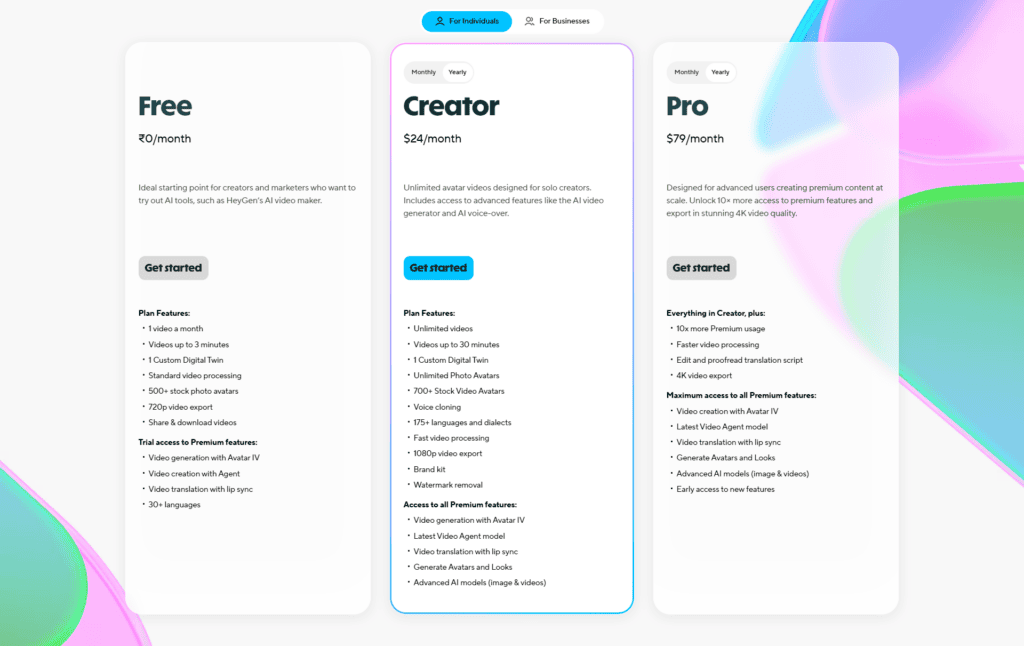
HeyGen is the easier starting point for individual creators because its paid Creator plan is lower than Colossyan’s Professional plan, while still including 600 monthly credits, 1080p export, watermark removal, voice cloning, and 175+ languages.
Colossyan Pricing Breakdown
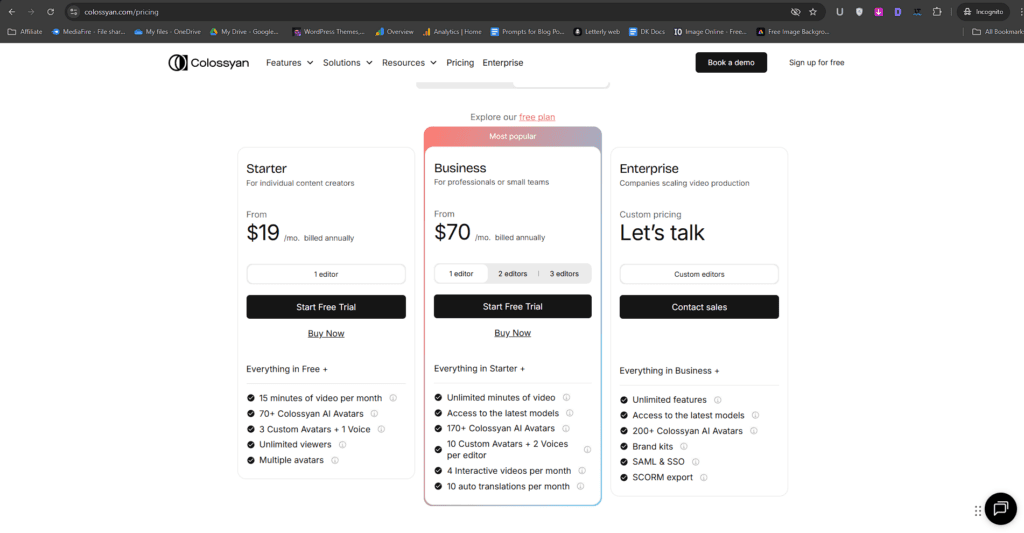
The main pricing detail to watch is the usage model. HeyGen uses credits across video and other assets, while Colossyan measures generated video in minutes and separates its NEO and NEO2 models. That makes the two plans difficult to compare purely by monthly price.
For teams, both move into higher-priced territory. HeyGen Business starts at $149/month plus $20 per additional seat, while Colossyan Professional is $59/month with $30 per additional member; Colossyan Enterprise adds unlimited NEO minutes, unlimited translations and SCORM exports, custom editors, analytics, and enterprise support.
Best Value for Money Verdict
For most solo creators, I’d pick HeyGen for overall pricing flexibility. Colossyan becomes more compelling when your main reason for paying is training, courses, SCORM, and structured learning content rather than general-purpose video production.
Real-World Use Cases — Which Tool Wins?
- Scalable marketing videos
- UGC-style ad creatives
- E-commerce product videos
- Social media content
- Multilingual video campaigns
- Personalized sales videos
- Fast creative testing
- Broad video production
Especially strong for:
- Content creators
- Marketers
- E-commerce brands
- Agencies
- Training videos
- Document-to-video workflows
- Employee onboarding
- Compliance content
- Interactive learning
- Course creation
- LMS-ready content
Especially strong for:
- L&D teams
- HR departments
- Corporate trainers
- Universities
My Recommendation by User Type
| User Type | Recommendation |
|---|---|
| Content creator | HeyGen |
| Performance marketer | HeyGen |
| E-commerce seller | HeyGen |
| Marketing agency | HeyGen |
| Corporate training team | Colossyan |
| Learning & development team | Colossyan |
| HR / onboarding team | Colossyan |
| Course creator | Colossyan |
Final Verdict (Honest Recommendation)
Here’s the honest answer:
Choose HeyGen If you want…
- More realistic avatar output, particularly when avatar quality is a major priority.
- A platform that goes beyond basic talking-head videos.
- Video translation with lip-sync for multilingual content.
- B-roll, image generation, video podcasts, UGC ads, and other supporting workflows in the same ecosystem.
- Batch creation when you need multiple versions of videos for different audiences, languages, or scripts.
- More flexibility for marketing, social media, YouTube, product content, and agency workflows.
- A scalable workflow where you can reuse avatars, voices, templates, and brand assets.
- Better overall value when you actually need several video-production capabilities rather than just avatar generation.
HeyGen is generally the better all-around AI video platform for creators and businesses that want to produce, repurpose, localize, and scale video from one place. The review particularly highlights its avatar realism, multilingual capabilities, and broader production toolkit.
Biggest strengths
- Avatar realism and lip-sync
- Broad video-production ecosystem
- Strong multilingual and localization workflow
- Excellent scaling features such as Batch Mode
- Strong value for frequent video creators
Biggest weakness
- It still isn’t a replacement for human video when deep emotional storytelling matters.
- Some expressions and voice synchronization can occasionally feel slightly off in longer or more complex videos.
- The review also notes that strong results depend heavily on having a good script.
Choose Colossyan If you want…
- A simple document-to-video workflow.
- To turn existing PDFs, presentations, notes, or training material into avatar videos without starting from scratch.
- Training and onboarding content where consistency matters more than cinematic creativity.
- A clean interface without a steep learning curve.
- Scene-by-scene editing where you can change avatars, backgrounds, text, and layouts independently.
- Built-in public avatars that can look surprisingly natural.
- A focused tool rather than a large collection of creative video features.
- AI avatar videos combined with course-creation capabilities.
Colossyan is more of a focused training and content-to-avatar platform than a complete AI video-production suite. Its document import is particularly useful because the review found that it can reuse existing PDF or PPTX material without requiring manual scene construction.
Biggest strengths
- Excellent document-to-video workflow
- Very beginner-friendly interface
- Strong public-avatar quality
- Useful scene-based editing
- Good fit for training, onboarding, and educational content
Biggest weakness
- Custom-avatar quality is the biggest problem.
- The hands-on test found stiff head movement, mismatched body language, and an overall artificial appearance compared with the built-in avatars.
- The platform also feels limited if you need B-roll, podcasting, advanced editing, or a broader video-production workflow.
FAQs (Quick Answers)
After testing both, I would choose HeyGen for most creators, marketers, and businesses because it gives me more flexibility for the money. I found it better suited to broader video production, including marketing content, multilingual videos, and workflows that need more than basic avatar videos.
Colossyan still has a clear place. I found it fast, simple, and useful for basic training videos, especially when turning existing documents into avatar-led content. But the custom-avatar quality was a major problem for me, and its narrower feature set makes it easier to outgrow. If you mainly need straightforward training content, Colossyan can work. For a more complete video workflow, I would pick HeyGen.